Showing posts with label Ortolan Bunting. Show all posts

Monday, 17 June 2013

Cyprus birds - Spring 2013

May 4-9, 2013:
A visit to the western side of the island yielded several interesting birds over this period. Places visited included the Asprokremnos dam area and its associated pools, Ezousas pools, Kouklea fish farm, Anarita park, Fassouri reed beds, Tunnel Beach and the adjacent cliffs, Akrotiri pools and church, Smygies, and the Teletria valley. Photographs of some of the birds seen are below.


Roller, top two at Anarita, lower at Teletria

Ortolan Bunting, Smygies

The endemic Cyprus Pied Wheatear, Smygies


Woodchat Shrike, Anarita park


Adult female Red-backed Shrike, Akrotiri
 
Eleonora's Falcon, distant view from the Kensington cliffs

Yellow Wagtail, Fassouri reed beds

Turtle Doves, near Fassouri


Spur-winged Lapwing, Ezousas pools


Ruff, Ezousas pools

Little Stint, Ezousas pools


Unidentified Harrier sp, Anarita park

Bee-eater (unfortunately against the light and distant), Latchi


Tuesday, 26 April 2011

Cyprus, March 29-April 7, 2011

Part 4: Cape Greco (the Holy Grail)
Cape Greco is a narrow peninsula in eastern Cyprus running south-eastwards towards Lebanon and Israel and is an important catchment area for incoming migrating birds from the Middle East. Fortunately, it is also protected from development as a nature reserve. In the past, many rarities have been recorded here, most recently last December when a male Hypocolius ampelinus (Grey Hypocolius, a type of Waxwing) became the first record for Europe and for the Western Palaearctic.


Despite the season being rather late, several very interesting birds were seen and photographed here during several visits over the period April 1-4. The terrain is low-lying, rocky and sandy with much scattered scrub and small dense bushes, the latter providing a shelter for the small migrants, especially Warblers. Over these few days, Wheatears were everywhere, the most common being Northern but also Isabelline, Cyprus Pied, and Black-eared.


[Northern Wheatear]


[Isabelline Wheatear]


[Cyprus Pied Wheatear]


[Black-eared Wheatear]

Several Hoopoes were feeding on open ground amongst the sparse vegetation and made a distinctly colourful sight against a background of blue sea and sky.


[Hoopoe]

Cretzschmar’s and Ortolan Buntings were also here as well as Corn buntings, Crested and Short-toed Larks, Whinchats and a solitary female Redstart.


[Cretzschmar's Bunting]


[Ortolan Buntings]


[Short-toed Lark]


[Redstart, female]

A little further inland where the vegetation was somewhat taller a very handsome Woodchat Shrike was found (see separate posting for this) and another pleasant surprise was a pair of Wrynecks with the male frequently displaying.


[Wryneck]

By keeping a patient close watch on the densest bushes, small warblers would be seen to emerge and feed on the insect life. These included Spectacled Warblers, Ruppell’s Warblers, Lesser Whitethroats and Blackcaps.


[Ruppell's Warbler]


[Spectacled Warbler]


[Lesser Whitethroats, pair]

Friday, 15 April 2011

Cyprus, March 29-April 7, 2011

Part 1. Asprokremnos
Photographs from this visit will be posted in four batches, this first one being of birds seen in the Asprokremnos area in the south-west. The season was rather late this year and many of the more exotic migrants such as Rollers, Bee-eaters and Golden Orioles were still to come.

On the scrub below the dam there were Northern Wheatears, Ortolan Buntings, Tawny Pipits and Crested Larks whilst on the nearby very small pool a Kingfisher waited patiently and a Little Crake put in a very brief appearance as it emerged from the depths of the fringing reed-bed.


[Northern Wheatear, male]


[Ortolan Bunting]


[Tawny Pipit]


[Crested Lark]


[Kingfisher]

For a day or two now a Long-legged Buzzard had been seen circling distantly within this general area but eventually it presented excellent views as it hunted along the steep hillside close to the dam. Apart from its light plumage and rusty-coloured undersides it differed from the Common Buzzard in its habit of occasionally hovering, Kestrel-like.


[Long-legged Buzzard]

In a wooded area near to the side of the dam a pair of Sardinian Warblers were feeding an early fledgling with the most minute flies imaginable.


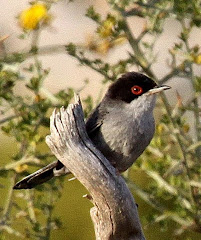
[Sardinian Warblers, female, male and chick]