Friday, 18 February 2011

Goldeneyes at Martin Mere


February 15, 2011:
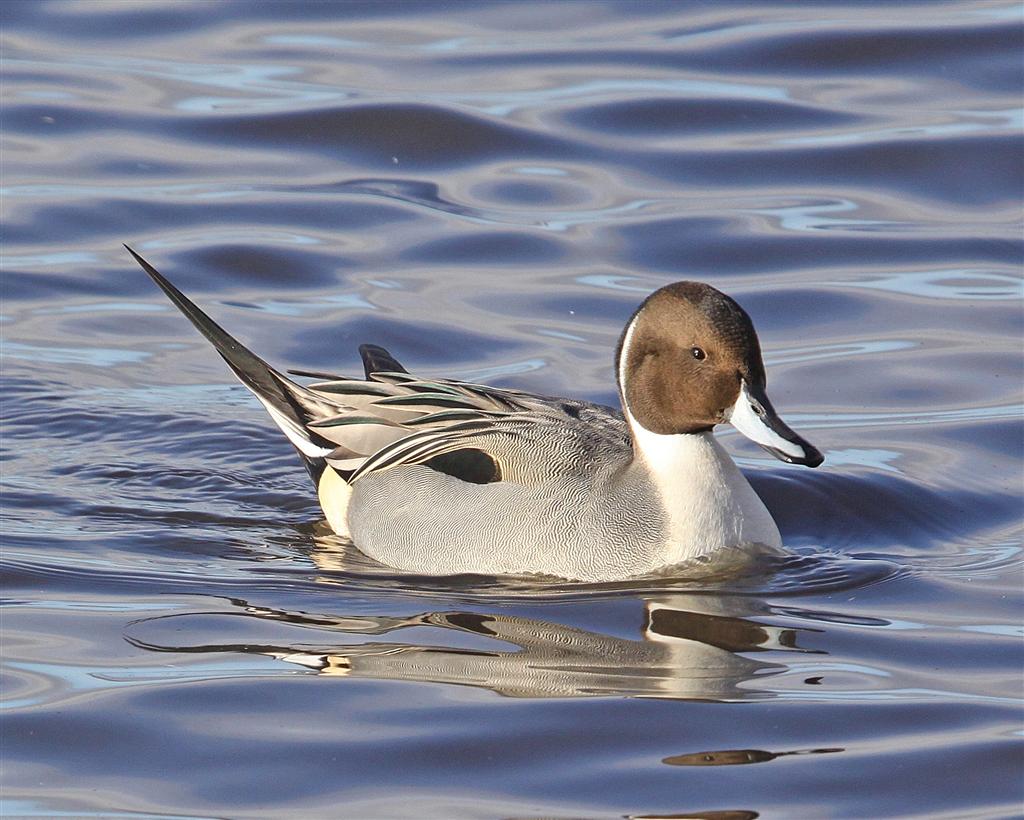
A short visit here was rewarded with sightings of a wide range of wildfowl which included good numbers of Whooper Swans, Greylags, Pochard, Teal, Wigeon, Mallard and Pintail. There was also a small group of finely-plumaged Goldeneye comprising four drakes and a female which always kept close together whilst diving and otherwise apparently aimlessly cruising the water


Tuesday, 8 February 2011

Ring-necked Duck at Fleetwood Marsh

February 8, 2011:
This drake had been reported here intermittently for the past ten days; when absent it was thought to be at a nearby reservoir. Today, it spent all the time at the furthest, inaccessible part of the lake and could not be viewed closer than 250 metres.


Ring-necked Ducks nest in northern North America and Canada and are strong migrants wintering in the south of that continent. Each year a few vagrants arrive in Britain, one bird (possibly the same one) was in seen in the area last year.


Present with it were about 15 Pochard and a similar number of Tufted Duck, several Mallard, two Goldeneye, a Great Crested Grebe and numerous Coot. It kept in loose association with the Pochard and particularly with one female with which it spent much time diving.


[Above, the drake second from left, with the much larger Mallard and slightly larger Pochard]


[Here with its diving companion, the female Pochard]

In appearance and plumage it exibited all the typical characters of the drake: a distinctly domed rear portion of its head, a prominent light stripe across its bill with a white band at the base, silvery-grey flanks with a white spur only at the front plus a faint white line running along the top, and markedly S-shaped flank panels.


After a long period of diving during which it seemed mainly to bring up weed, it did a little flapping and preening before drifting away into the reed bed to sleep.


Sunday, 6 February 2011

A Smew at Brockholes Wetlands but in vile weather

February 6, 2011;
Since the autumn there have been intermittent reports of Smew, both male and female/juvenile, being sighted on the Ribble in the vicinity of the Reserve or roosting on a nearby reservoir. Just before the end of the year a bird spent several days on the icy river below the M6 bridge (see earlier posting for December 29) whilst during this past week up to three birds (including one drake) were seen on the river above the weir. They would therefore seem to be wintering in the area but are very elusive and probably under-recorded since upstream from the reserve the river has virtually no public access over a 7-kilometre stretch.

In today's appalling weather (wet, dark, and with near gale-force winds) a female/juvenile Smew was on No.1 pool, consorting with at least ten Pochard and a similar number of Goldeneye. Watched for a while before being defeated by the weather, it could be seen preening and occasionally diving whilst riding out the semi-gale.


[Preening, two photos above]

A few very indifferent photos (above) were taken at long range in very poor light and through a constantly vibrating scope. Under the circumstances it was fortunate that any recognisable images were obtained.

Saturday, 29 January 2011

An hour locally with the Reed Buntings

January 29, 2011:
A beautifully clear, bright day but with the temperature only just above zero, seemed ideal for a stroll around Brockholes Wetlands. Very prominent were the Reed Buntings, often very frequent here, and regular nesters in the marginal reed beds during the summer.


Both of the main pools were mostly frozen over but on No.1 pool especially, a large number of gulls and wildfowl were concentrated on the limited area of open water. Apart from the usual large flocks of Mallard and Canada Geese, there were also many Tufted Duck as well as several Goldeneye and Teal. At the water's edge a Dunlin, a Snipe and several Redshank foraged.

Thursday, 20 January 2011

The elusive Long Marton Shrike

January 19, 2011:
About ten days ago a Great Grey Shrike had been seen near to the village of Long Marton near Appleby in the Eden valley, Cumbria. Last Friday (the 14th) I decided to make the trip to try to find the bird as it had been seen again on the previous day. The area which it frequented comprised open countryside north of the village, mainly farmland, with scattered trees and hedgerows. However, after scouring the area for three hours, there was no sign of the bird and I returned home but only to find later that it had been seen again that same afternoon.


So a return round-trip in excess of 150 miles had to wait until today. Again the outcome seemed unpromising as time went by with no appearance of the bird until in failing light in late afternoon it was sighted perched on overhead wires near to the road junction to Knock. There was just chance for a few distant photos before it flew off but it was soon re-found giving good views perched in typical Shrike fashion on the uppermost tips of trees along the roadside hedgerow. Again a few photos were possible before it disappeared in the gathering gloom not to be seen again. In looking for the Shrike, I had spent more than seven hours over two days as well as four hours travelling time but in the end it was all very worthwhile. Like the two drake Smews at Talkin two weeks ago, these Cumbrian birds seem only to make an appearance late in the day!


For the Shrike there was much suitable territory near Long Marton and its ability to move quickly around made it a frustrating and elusive bird to catch sight of. In the end, however, luck played its part.


Two Buzzards were also seen circling high nearby plus a Kestrel and two Great Spotted Woodpeckers along with many other of the commoner birds.


[Great Spotted Woodpeckers seemed to be quite common here]

Also, there was a beautiful sunset over the Lakeland hills seen on the way home.

Tuesday, 18 January 2011

Pintail and Teal at Martin Mere Wetlands

January 18, 2011:
Today was a beautiful morning with sunshine providing a clear bright light so that despite the biting wind there was just a suggestion of the Spring to come. All the ice had now melted and a large number of wildfowl were taking advantage of the open water. Apart from huge flocks of Whooper Swans and Pink-feet there were sizeable numbers of ducks, especially Pintail and Teal, which each kept together in their own tight group.


The drake Pintails were in magnificent plumage and cruised around serenely. Several times a female would provide the centre of attraction and become almost coralled by the admiring drakes swimming close by.


[Get out of that - but she did]


Much the same occurred with the Teal whilst others fed closer to the bank.


[Tight group of Teal]


There were also Wigeon, Shelduck, Shoveler and several Coot probing in the mud.


Tuesday, 11 January 2011

Red-necked Grebe at Fairhaven Lake


January 11: 2011:
This juvenile Red-necked Grebe had been at the lake for several days now. It was quite a confiding bird and would occasionally come close to the side despite people walking by. Being a juvenile its was not as colourfully marked as the summer adults of course but several distinctive characters were evident such as the reddish-brown colouration to the neck, the yellow base to the bill, and the typical 'powder puff' appearance of its rear end. It was larger bird than a Little Grebe but noticeably smaller than a Great Crested Grebe.


It spent much of its time diving, sometimes successfully, but at one point carried out a prolonged period of preening and flapping when almost every one of its feathers seemed to have been examined.


On another occasion it was distracted from its diving when surfacing close to a floating white feather discarded by a gull. This seemed to provide a great fascination as it spent several minutes picking it up and throwing it about as if playing with it.


Red-necked Grebes are mainly birds of northern latitudes, those arriving here will have come from northern-central Europe. They are a scarce winter visitor which are thought to nest occasionally in the U.K. but at localities which are kept secret.

Other than the resident Mallard, there was also a pair of Red-breasted Mergansers fishing on the lake. Presumably it's a good feeding spot for diving birds.