Monday, 30 May 2011

Spotted Sandpiper at Brockholes Wetlands, Lancashire

May 30, 2011:
First reported this morning, the bird attracted a large number of watchers to the newly opened Reserve. A visitor from North America, it is only the fifth record for Lancashire, the previous one was at Stocks Reservoir just over a year ago. Prior to that it was 1987.


The bird spent today on No.1 pool, at first moving to several different places before finally settling for the stony shoreline near the Sand Martin bank where there was also a Turnstone, a Redshank and a Common Sandpiper. It was in full adult summer plumage having a heavily spotted breast and underparts, a prominent eye-stripe, a pinkish bill with a black tip and yellowish legs. Hopefully it will stay for a while, but maybe not.

Unfortunately it never came sufficiently close for good photographs and the heavy morning rain didn't help either.


A few of the many watchers who came to see the bird during the day.

Monday, 16 May 2011

Sedge Warbler near Silverdale, Lancashire

April 29, 2011:
I spent two hours here patiently waiting to photograph an extremely elusive Grasshopper Warbler but in the end was unsuccessful. Directly behind me and quite close by, this Sedge Warbler showed no such inhibitions and sang exuberantly for much of the time.


Saturday, 30 April 2011

Cyprus, March 29-April 7, 2011

Part 5 (final), Cape Greco, Woodchat Shrike:
The peninsula at Cape Greco is important for migrants (see earlier), the low-lying, rocky terrain and scattered scrub acting as a haven for incoming birds. In one area where the vegetation was somewhat taller a very handsome Woodchat Shrike had staked out a feeding territory.


Although elusive at first, with patience it was possible to approach quite closely using intervening bushes as cover and eventually to within 25 metres giving good views as it frequently dropped from its perch to pounce on prey below. Even so, it was clearly aware of my presence and kept a wary eye on me by frequently looking back over its shoulder. Like most Shrikes it had selected prominent perches on small sparsely-vegetated trees. It appeared to have just three of these, seemingly moving around them at random. From its head patterning it appeared to be a male.


On returning the following day there was no sign of the bird, it presumably having moved further along its journey. Its destination would probably be mainland Europe since Woodchats only rarely nest in Cyprus.


[The rough scrubby garrigue favoured by the Shrike]

Tuesday, 26 April 2011

Cyprus, March 29-April 7, 2011

Part 4: Cape Greco (the Holy Grail)
Cape Greco is a narrow peninsula in eastern Cyprus running south-eastwards towards Lebanon and Israel and is an important catchment area for incoming migrating birds from the Middle East. Fortunately, it is also protected from development as a nature reserve. In the past, many rarities have been recorded here, most recently last December when a male Hypocolius ampelinus (Grey Hypocolius, a type of Waxwing) became the first record for Europe and for the Western Palaearctic.


Despite the season being rather late, several very interesting birds were seen and photographed here during several visits over the period April 1-4. The terrain is low-lying, rocky and sandy with much scattered scrub and small dense bushes, the latter providing a shelter for the small migrants, especially Warblers. Over these few days, Wheatears were everywhere, the most common being Northern but also Isabelline, Cyprus Pied, and Black-eared.


[Northern Wheatear]


[Isabelline Wheatear]


[Cyprus Pied Wheatear]


[Black-eared Wheatear]

Several Hoopoes were feeding on open ground amongst the sparse vegetation and made a distinctly colourful sight against a background of blue sea and sky.


[Hoopoe]

Cretzschmar’s and Ortolan Buntings were also here as well as Corn buntings, Crested and Short-toed Larks, Whinchats and a solitary female Redstart.


[Cretzschmar's Bunting]


[Ortolan Buntings]


[Short-toed Lark]


[Redstart, female]

A little further inland where the vegetation was somewhat taller a very handsome Woodchat Shrike was found (see separate posting for this) and another pleasant surprise was a pair of Wrynecks with the male frequently displaying.


[Wryneck]

By keeping a patient close watch on the densest bushes, small warblers would be seen to emerge and feed on the insect life. These included Spectacled Warblers, Ruppell’s Warblers, Lesser Whitethroats and Blackcaps.


[Ruppell's Warbler]


[Spectacled Warbler]


[Lesser Whitethroats, pair]

Thursday, 21 April 2011

Cyprus, March 29-April 7, 2011

Part 3: Fassouri Reed-beds and Larnaca Salt-lake
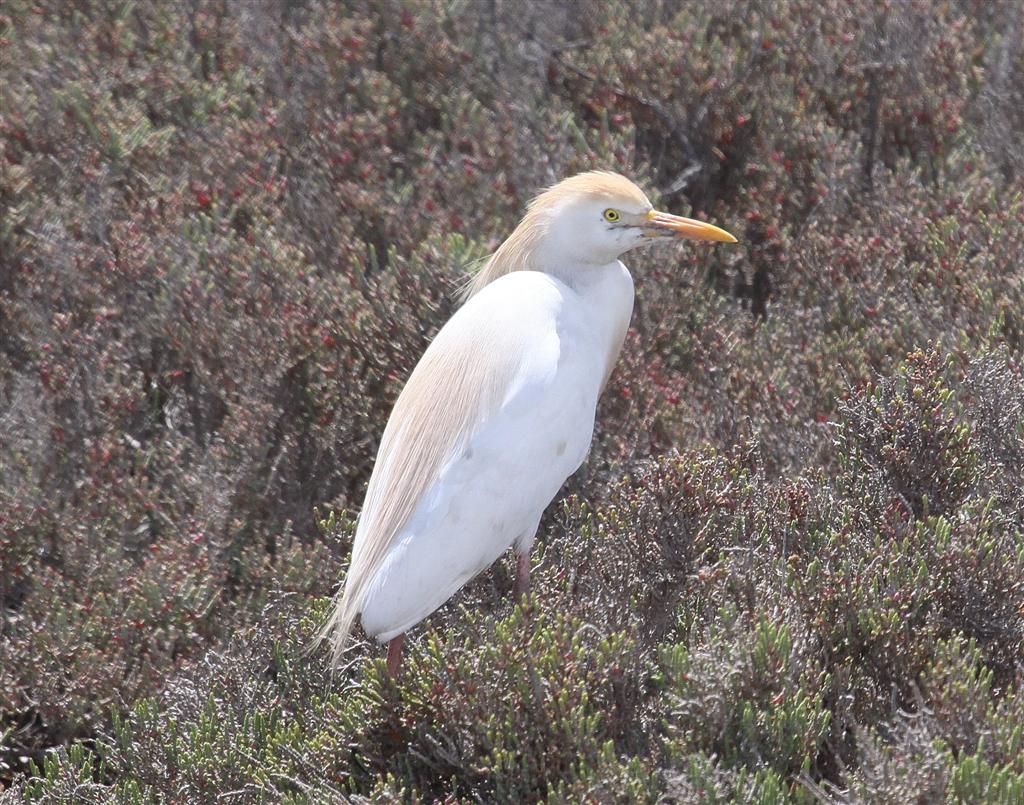
At Fassouri the pools held much water and even some of the surrounding pasture had large puddles as result of an overnight storm. A Cattle Egret, a Little Egret and several Purple Herons were present and a Marsh Harrier displayed over the reed beds.


[Cattle Egret]


[Purple Heron]


[Fassouri]

One bird, which through its lack of fear and mode of flight when finally flushed, was identified as a Great Snipe whilst several other Common Snipe were there also.


[Great Snipe]

On some of the rain-flooded puddles Green and Wood Sandpipers as well as two Ruff were feeding.


[Wood and Green Sandpipers]


[Wood Sandpiper]


[Ruff, etc]

On the shallow salt lake at Larnaca the Flamingos were far out in the centre of the shallow water and so consequently unapproachable for reasonable photography. More accommodating were seven Black-winged Stilts and two Cattle Egrets on the small adjacent lake.


[Flamingos]


[Cattle Egret, both above]


[Black-winged Stilts]

Tuesday, 19 April 2011

Garganey at Leighton Moss, Lancashire

April 19, 2011
A pair of Garganey had been on the fen pools here over the last few days. These are distinctly scarce ducks, only seen occasionally in north-west England.


The birds had been reported as being quite shy, often spending much of the time hidden in the reed-beds so the chance of getting a good view seemed slight. This was reinforced as I approached when meeting a friend who was just leaving who had only had a very brief view of one bird. This time, however, my luck was in because just a I reached the pool the drake had come out into open water where it was up-ending. After a while it was joined by the female.


Views were relatively close and it was surprising to notice how small Garganey actually are, only slightly larger than a Teal. Nearby Tufted Duck and Pochard looked huge in comparison.