A small group of Arctic Terns have been hawking over the Ribbleton pool here for several days now. Their fast, agile, and unpredictable flight makes them difficult subjects for photography.
Sunday, 21 April 2013
Arctic Terns at Brockholes Wetlands
April 19, 2013:
A small group of Arctic Terns have been hawking over the Ribbleton pool here for several days now. Their fast, agile, and unpredictable flight makes them difficult subjects for photography.
Tuesday, 19 March 2013
Lesser Scaup at Brockholes Wetlands
March 15, 2013:
Today, there was a first record for the Reserve when a drake Lesser Scaup arrived at the Meadow pool overnight.
There, it consorted with a small flock of Tufted Duck but could only be viewed at long range as it remained close to the reed beds on far, eastern, side of the lake. It spent most of the time diving or sleeping out on the water and had departed by the following morning.
It was slightly smaller than the Tufted Ducks. Through the scope, its somewhat pointed head with a purplish sheen and its pale strongly vermiculated back could be clearly seen. Although usually rather inactive, one observer sighted its white wing-bar. The Lesser Scaup is a vagrant from America, the first British record not being until 1987 in Staffordshire; since then there have been approximately a hundred more with at least three from the North-west.
Today, there was a first record for the Reserve when a drake Lesser Scaup arrived at the Meadow pool overnight.
There, it consorted with a small flock of Tufted Duck but could only be viewed at long range as it remained close to the reed beds on far, eastern, side of the lake. It spent most of the time diving or sleeping out on the water and had departed by the following morning.
It was slightly smaller than the Tufted Ducks. Through the scope, its somewhat pointed head with a purplish sheen and its pale strongly vermiculated back could be clearly seen. Although usually rather inactive, one observer sighted its white wing-bar. The Lesser Scaup is a vagrant from America, the first British record not being until 1987 in Staffordshire; since then there have been approximately a hundred more with at least three from the North-west.
Much credit to Bill Aspin for spotting it amongst the Tufted flock.
Wednesday, 6 March 2013
Owls on the Lancashire Fylde
March 5, 2013:
A nice sunny day today but despite this at least three species of owl were active in the area during the afternoon.
Two Short-eared Owls hunted together over the rough farmland, perching frequently in the hawthorn hedgerows where they were usually partially concealed, although occasionally a better view could be obtained.
Nearby a Barn Owl also hunted, not harrassed by the other two, although later attacked by corvids which required avoiding action.
In its favourite tree some distance away a Little Owl made the most of the sunny weather
A nice sunny day today but despite this at least three species of owl were active in the area during the afternoon.
Two Short-eared Owls hunted together over the rough farmland, perching frequently in the hawthorn hedgerows where they were usually partially concealed, although occasionally a better view could be obtained.
Nearby a Barn Owl also hunted, not harrassed by the other two, although later attacked by corvids which required avoiding action.
In its favourite tree some distance away a Little Owl made the most of the sunny weather
Monday, 28 January 2013
Ivory Gull - an arctic retrospective from Spitsbergen, 2008
Recently, matters birdwise have been rather quiet locally so below are a few photos from the arctic of an Ivory Gull which I saw in Spitsbergen in July 2008. Like many birds when in arctic surroundings they can be quite approachable and show little fear of humans. This bird was scavenging on wet partially bare earth for what little food was available. There was only time for a few photos before it flew off to try elsewhere. Its characteristic orange-tipped, grey-blue beak shows up well and the plumage is pure white.
Sunday, 2 December 2012
Barn Owl and Short-eared Owls in Lancashire
December 1, 2012:
During the winter months, the low-lying moss-lands of Lancashire can be the haunt of Short-eared Owls as well as the regular hunting ground of resident Barn Owls. Other scarce raptors are also sometimes seen here.
Today, in bright sunshine, a Barn Owl and two Short-eared Owls could be seen periodically together quartering the same rough farm land in search of prey.
During the winter months, the low-lying moss-lands of Lancashire can be the haunt of Short-eared Owls as well as the regular hunting ground of resident Barn Owls. Other scarce raptors are also sometimes seen here.
Unfortunately, the Short-eared Owls failed to perch within camera range.
Saturday, 3 November 2012
Long-tailed Duck at Stocks Reservoir, Lancashire
October 31, 2011:
The bird was first sighted the previous day towards the eastern end of the reservoir but was always distant allowing only record shots..
In the rough weather it was often hidden by the waves and was difficult to pick out amongst the large number of other wildfowl present which included Mallard,Tufted Duck and Pintail. Later, it detached itself and could be seen distantly diving alone for a while in the rough water. It appeared to be an adult female rather than an immature bird.
The bird was first sighted the previous day towards the eastern end of the reservoir but was always distant allowing only record shots..
In the rough weather it was often hidden by the waves and was difficult to pick out amongst the large number of other wildfowl present which included Mallard,Tufted Duck and Pintail. Later, it detached itself and could be seen distantly diving alone for a while in the rough water. It appeared to be an adult female rather than an immature bird.
Wednesday, 24 October 2012
Lesser Yellowlegs at Aldcliffe, Lancaster
October 24, 2012:
The juvenile Lesser Yellowlegs spent most of its time alternating between a large flooded field near the lane end and the far northern part of a string of shallow pools about half a kilometre away. Both spots couldn't be watched at the same time. As one approached one of these it would frustratingly fly to the other, so the answer was to stay put and just wait. At either spot it was almost always distant but on one occasion it did come within 100 metres or so.
A north American bird which usually winters in the south of that continent, there have been over 400 UK records, this is about the 12th for Lancashire.
The short white supercilium not extending beyond the eye, the fine beak, the rather elegant build, and yellowish legs, can be seen seen in some of these (rather distant) photos.
The juvenile Lesser Yellowlegs spent most of its time alternating between a large flooded field near the lane end and the far northern part of a string of shallow pools about half a kilometre away. Both spots couldn't be watched at the same time. As one approached one of these it would frustratingly fly to the other, so the answer was to stay put and just wait. At either spot it was almost always distant but on one occasion it did come within 100 metres or so.
Its yellowish legs are just visible
Thursday, 18 October 2012
Pallas's Warbler at Knott End, Lancashire
October 18, 2012:
After a long bleak autumn for interesting birds locally, a Pallas's Warbler arrived at Knott End on Monday (the 15th). Since then, it has spent most of its time hunting insects in and around a sycamore tree in a garden which backs onto the sea wall.
It was very elusive and fast moving amongst the leaves and branches and being so small, was difficult to follow never mind to photograph. Eventually, it came slightly more into the open for a few seconds allowing some distant photos before vanishing again.
Pallas's Warblers breed in an area eastwards from Siberia to north-east China and usually winter in southern China although small numbers can also arrive in western Europe. It was watched by quite a large group of people today. Many thanks to Chris Batty for allowing access to his garden.
Its characteristic pale cream rump, the bright yellow crown stripe and the prominent dark eye stripe can be seen.
After a long bleak autumn for interesting birds locally, a Pallas's Warbler arrived at Knott End on Monday (the 15th). Since then, it has spent most of its time hunting insects in and around a sycamore tree in a garden which backs onto the sea wall.
It was very elusive and fast moving amongst the leaves and branches and being so small, was difficult to follow never mind to photograph. Eventually, it came slightly more into the open for a few seconds allowing some distant photos before vanishing again.
Pallas's Warblers breed in an area eastwards from Siberia to north-east China and usually winter in southern China although small numbers can also arrive in western Europe. It was watched by quite a large group of people today. Many thanks to Chris Batty for allowing access to his garden.
Its characteristic pale cream rump, the bright yellow crown stripe and the prominent dark eye stripe can be seen.
Sunday, 15 July 2012
A Montagu's Harrier at Champion Moor, Lancashire
July 12-15, 2012:
A male Montagu's Harrier, a species which in Britain is usually restricted to the Norfolk area, was first spotted here on Wednesday, the11th, by sharp-eyed Burnley bird-watcher Graham Gavaghan. This appears to be the first-ever record for the Bowland area although the related Hen Harrier occasionally passes through. By weekend as the word spread, up to 100 watchers took up strategic positions on the narrow country roads across the moor.
The bird appeared to restrict itself to an area perhaps one mile in diameter comprising rough grassland over which it periodically hunted. This was usually at very low level, little more than wall-top height and with a twisting flight, but occasionally it would soar high before descending to another part of the moor. When on the ground it was usually hidden amongst the vegetation, sometimes for up to two hours or more, but it would eventually take flight and make a foray over the moor in search of prey.
On one occasion it perched on a broken wall and spent much time preening but most views were when in flight. It had a large area of black towards the wing tips, the arrangement of its primary wing feathers was typical (visible in the top photo), and it had a long tail and a sleek appearance. Unfortunately the bird was usually quite distant making detailed photographs difficult.
A male Montagu's Harrier, a species which in Britain is usually restricted to the Norfolk area, was first spotted here on Wednesday, the11th, by sharp-eyed Burnley bird-watcher Graham Gavaghan. This appears to be the first-ever record for the Bowland area although the related Hen Harrier occasionally passes through. By weekend as the word spread, up to 100 watchers took up strategic positions on the narrow country roads across the moor.
The bird appeared to restrict itself to an area perhaps one mile in diameter comprising rough grassland over which it periodically hunted. This was usually at very low level, little more than wall-top height and with a twisting flight, but occasionally it would soar high before descending to another part of the moor. When on the ground it was usually hidden amongst the vegetation, sometimes for up to two hours or more, but it would eventually take flight and make a foray over the moor in search of prey.
On one occasion it perched on a broken wall and spent much time preening but most views were when in flight. It had a large area of black towards the wing tips, the arrangement of its primary wing feathers was typical (visible in the top photo), and it had a long tail and a sleek appearance. Unfortunately the bird was usually quite distant making detailed photographs difficult.
Soaring, and so arousing fears of an imminent and permanent departure
Sunday, 1 July 2012
Hobby at Brockholes Wetlands, Lancashire
June 27, 2012:
Today a Hobby was making regular circuits of the pools, sometimes banking and swerving to take insects, probably dragonflies. On one occasion (photo sequence below) it appeared to catch something much larger which so far remains unidentified.
Monday, 14 May 2012
A Common Scoter at Brockholes Wetlands, Lancashire
May 12, 2012:
A Common Scoter which arrived on No.2 pool yesterday appears to be the first record for the site. It was a rather wary bird, keeping its distance from anyone approaching, but spent much of the time diving with periods of 45 seconds or more under water. An almost mature drake, the yellow marking on its bill could be clearly seen from quite a distance.
Sunday, 6 May 2012
A sunny week in Cyprus
April 22-27, 2012:
After what had been a cold and very wet winter, this week fortunately coincided with superb weather with blue skies and temperatures into the eighties for the whole time. Based mostly in south-west Cyprus at Nikoklea, much time was spent within the local area looking at several forms of wildlife with additional visits to the Akrotiri district, Cedar Valley, and the Troodos.
It was good to see three separate species of Shrike including six Woodchats at the Akrotiri gravel pits and four others below the Asprokremnos dam, two sightings of Masked Shrikes at Cedar valley and Akrotiri, and a Red-backed Shrike on the overhead wires at Ayia Varvara. Here also on other wires was a very friendly Little Owl whilst a Great Spotted Cuckoo was continuously harassed by up to six Magpies.
At the Phassouri reed beds (Akrotiri) there were Glossy Ibises, Cattle Egrets, Little Ringed Plovers, Spur-winged Plovers, Wood and Green Sandpipers, Ruff, Coot and a single Ferruginous Duck.
The isolated churchyard of Ayios Georgios in the desert-like habitat near Akrotiri acts as an oasis for incoming migrants and had attracted several Collared and Spotted Flycatchers as they passed through the island; there was also a Kentish Plover nearby The steep chalk cliffs at Tunnel beach were searched for raptors and produced a Peregrine along with a brief view of an Eleonora's Falcon, probably an immature bird, as it flew along the cliff face.
Coastal pools near to the airport had Grey and Purple Heron perched in the surrounding tamarisks shrubs, Squaccos by the waterside with Wood Sandpipers and a Little Crake on the muddy margin. At one point an Osprey came in off the sea to be mobbed by Hooded Crows. Other raptor sightings elsewhere included a Bonelli's Eagle at Kidasi and a distant view of the recently-reported Pallid Harrier at Mandrea.
Earlier in the week two Collared Pratincoles hawked for insects over stubble fields at Mandrea and on the last day one of them could be seen perched distantly on some off-shore rocks
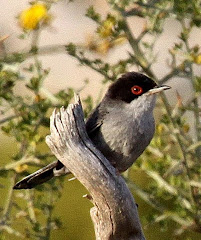
The scrub below the Asprokremnos dam is another haven for both migrants and residents such as Cyprus and Sardinian Warblers and Crested Larks. A Stone Curlew flew through here briefly and there were also Whinchats, Ortolan Buntings and Northern Wheatear (as well as several Woodchats).
After what had been a cold and very wet winter, this week fortunately coincided with superb weather with blue skies and temperatures into the eighties for the whole time. Based mostly in south-west Cyprus at Nikoklea, much time was spent within the local area looking at several forms of wildlife with additional visits to the Akrotiri district, Cedar Valley, and the Troodos.
Woodchat, Asprokremnos
It was good to see three separate species of Shrike including six Woodchats at the Akrotiri gravel pits and four others below the Asprokremnos dam, two sightings of Masked Shrikes at Cedar valley and Akrotiri, and a Red-backed Shrike on the overhead wires at Ayia Varvara. Here also on other wires was a very friendly Little Owl whilst a Great Spotted Cuckoo was continuously harassed by up to six Magpies.
Masked Shrike, Akrotiri
Red-backed Shrike, Ayia Varvara
Little Owl, Ayia Varvara
Great Spotted Cuckoo, Ayia Varvara
Glossy Ibises, Fassouri
Little Ringed Plover, Fassouri
A rather distant Ferruginous Duck, Fassouri
Spur-winged Plovers, Fassouri
The isolated churchyard of Ayios Georgios in the desert-like habitat near Akrotiri acts as an oasis for incoming migrants and had attracted several Collared and Spotted Flycatchers as they passed through the island; there was also a Kentish Plover nearby The steep chalk cliffs at Tunnel beach were searched for raptors and produced a Peregrine along with a brief view of an Eleonora's Falcon, probably an immature bird, as it flew along the cliff face.
Collared Flycatcher, Akrotiri
Spotted Flycatcher, Akrotiri
Eleonora's Falcon, Tunnel Beach
Coastal pools near to the airport had Grey and Purple Heron perched in the surrounding tamarisks shrubs, Squaccos by the waterside with Wood Sandpipers and a Little Crake on the muddy margin. At one point an Osprey came in off the sea to be mobbed by Hooded Crows. Other raptor sightings elsewhere included a Bonelli's Eagle at Kidasi and a distant view of the recently-reported Pallid Harrier at Mandrea.
Purple Heron
Osprey harassed by Hooded Crow
Collared Pratincole hawking for insects, Mandrea
Collared Pratincole, Mandrea
The scrub below the Asprokremnos dam is another haven for both migrants and residents such as Cyprus and Sardinian Warblers and Crested Larks. A Stone Curlew flew through here briefly and there were also Whinchats, Ortolan Buntings and Northern Wheatear (as well as several Woodchats).
Sardinian Warbler, Asprokremnos
Whinchat, Asprokremnos
Amother friendly Woodchat at Asprokremnos
Subscribe to:
Posts (Atom)
.jpg)


.jpg)
.jpg)
.jpg)
.jpg)
.jpg)
.jpg)
.jpg)
.jpg)
.jpg)


.jpg)


.jpg)


.jpg)


.jpg)
.jpg)


.jpg)
.jpg)
.jpg)
.jpg)
.jpg)
.jpg)
.jpg)
.jpg)
.jpg)
.jpg)
.jpg)
.jpg)
.jpg)
.jpg)
.jpg)
.jpg)
.jpg)
.jpg)
.jpg)
.jpg)
.jpg)