Sunday, 15 July 2012

A Montagu's Harrier at Champion Moor, Lancashire

July 12-15, 2012:
A male Montagu's Harrier, a species which in Britain is usually restricted to the Norfolk area, was first spotted here on Wednesday, the11th, by sharp-eyed Burnley bird-watcher Graham Gavaghan. This appears to be the first-ever record for the Bowland area although the related Hen Harrier occasionally passes through. By weekend as the word spread, up to 100 watchers took up strategic positions on the narrow country roads across the moor.


The bird appeared to restrict itself to an area perhaps one mile in diameter comprising rough grassland over which it periodically hunted. This was usually at very low level, little more than wall-top height and with a twisting flight, but occasionally it would soar high before descending to another part of the moor. When on the ground it was usually hidden amongst the vegetation, sometimes for up to two hours or more, but it would eventually take flight and make a foray over the moor in search of prey.


On one occasion it perched on a broken wall and spent much time preening but most views were when in flight. It had a large area of black towards the wing tips, the arrangement of its primary wing feathers was typical (visible in the top photo), and it had a long tail and a sleek appearance. Unfortunately the bird was usually quite distant making detailed photographs difficult.


Soaring, and so arousing fears of an imminent and permanent departure

Sunday, 1 July 2012

Hobby at Brockholes Wetlands, Lancashire

June 27, 2012:
Today a Hobby was making regular circuits of the pools, sometimes banking and swerving to take insects, probably dragonflies. On one occasion (photo sequence below) it appeared to catch something much larger which so far remains unidentified.


Monday, 14 May 2012

A Common Scoter at Brockholes Wetlands, Lancashire

May 12, 2012:
A Common Scoter which arrived on No.2 pool yesterday appears to be the first record for the site. It was a rather wary bird, keeping its distance from anyone approaching, but spent much of the time diving with periods of 45 seconds or more under water. An almost mature drake, the yellow marking on its bill could be clearly seen from quite a distance.

Sunday, 6 May 2012

A sunny week in Cyprus

April 22-27, 2012:
After what had been a cold and very wet winter, this week fortunately coincided with superb weather with blue skies and temperatures into the eighties for the whole time. Based mostly in south-west Cyprus at Nikoklea, much time was spent within the local area looking at several forms of wildlife with additional visits to the Akrotiri district, Cedar Valley, and the Troodos.

Woodchat, Asprokremnos

It was good to see three separate species of Shrike including six Woodchats at the Akrotiri gravel pits and four others below the Asprokremnos dam, two sightings of Masked Shrikes at Cedar valley and Akrotiri, and a Red-backed Shrike on the overhead wires at Ayia Varvara. Here also on other wires was a very friendly Little Owl whilst a Great Spotted Cuckoo was continuously harassed by up to six Magpies.

Masked Shrike, Akrotiri

Red-backed Shrike, Ayia Varvara

Little Owl, Ayia Varvara

Great Spotted Cuckoo, Ayia Varvara

At the Phassouri reed beds (Akrotiri) there were Glossy Ibises, Cattle Egrets, Little Ringed Plovers, Spur-winged Plovers, Wood and Green Sandpipers, Ruff, Coot and a single Ferruginous Duck.

Glossy Ibises, Fassouri

Little Ringed Plover, Fassouri

A rather distant Ferruginous Duck, Fassouri

Spur-winged Plovers, Fassouri

The isolated churchyard of Ayios Georgios in the desert-like habitat near Akrotiri acts as an oasis for incoming migrants and had attracted several Collared and Spotted Flycatchers as they passed through the island; there was also a Kentish Plover nearby The steep chalk cliffs at Tunnel beach were searched for raptors and produced a Peregrine along with a brief view of an Eleonora's Falcon, probably an immature bird, as it flew along the cliff face.


Collared Flycatcher, Akrotiri

Spotted Flycatcher, Akrotiri

Eleonora's Falcon, Tunnel Beach

Coastal pools near to the airport had Grey and Purple Heron perched in the surrounding tamarisks shrubs, Squaccos by the waterside with Wood Sandpipers and a Little Crake on the muddy margin. At one point an Osprey came in off the sea to be mobbed by Hooded Crows. Other raptor sightings elsewhere included a Bonelli's Eagle at Kidasi and a distant view of the recently-reported Pallid Harrier at Mandrea.


Purple Heron

Osprey harassed by Hooded Crow

Earlier in the week two Collared Pratincoles hawked for insects over stubble fields at Mandrea and on the last day one of them could be seen perched distantly on some off-shore rocks

Collared Pratincole hawking for insects, Mandrea

Collared Pratincole, Mandrea

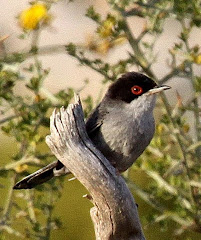
The scrub below the Asprokremnos dam is another haven for both migrants and residents such as Cyprus and Sardinian Warblers and Crested Larks. A Stone Curlew flew through here briefly and there were also Whinchats, Ortolan Buntings and Northern Wheatear (as well as several Woodchats).

Sardinian Warbler, Asprokremnos

Whinchat, Asprokremnos

Amother friendly Woodchat at Asprokremnos

Thursday, 29 March 2012

Great Grey Shrike on Longridge Fell. Removing the sting from a bumblebee

March 25, 2012:
The bird has now been here for at least two weeks. It can be elusive though and is easily lost from sight amongst the tangled debris following tree felling. Recently the weather has been superb and bumblebees are now emerging. Today it could be seen removing the sting from one of these prior to eating it. At other times it would catch flies in mid-air off a favourite high perch.


Removing a sting


The debris-strewn area usually occupied by the bird. It can be seen as a minute speck in the centre of the middle distance horizon.

Tuesday, 27 March 2012

Hawfinches at Sizergh Castle, Cumbria


March 27, 2012:
Hawfinches have recently been reported to be showing well at one of their best-known Cumbria locations at the castle car-park. Hornbeam and beech fruits normally provide their food here but at this stage of late winter it has been supplemented by a human agency with additonal seed. It is rare to get such good, close views of Hawfinches and at least five birds were present today. However, an early start is necessary to be sure of seeing them before the car-park reverts to its normal use.


Bullfinches, Greenfinches, a Jackdaw and a Blackbird also joined in the free meal


Wednesday, 21 March 2012

A Goshawk at a site in northern England

March 19, 2012:
Northern Goshawks (Accipiter gentilis) are perhaps the most difficult resident raptors to identify with certainty due to a similarity to Sparrowhawks. There is an apt saying that if you are unsure if it’s a Goshawk, then it’s a Sparrowhawk. These are secretive birds, usually inhabiting extensive tracts of relatively remote coniferous woodland, so that sightings are usually when airborne and even then can be infrequent, distant, and rather brief. In early spring, birds display near their nesting grounds which gives the best opportunity to see them. Like many raptors they are prone to persecution and, as they only occur in small numbers, it’s important that localities are not publicised.


This morning, over an an area of wooded fell-side, this bird put in an appearance between Sparrowhawk sightings. At the time there was a short burst of sunshine but the bird was distant against a bright sky so making photography very difficult. The composite photo was taken in a five second period as the bird circled away to the right. The bottom right photo best shows its typical bulky flight silhouette. Identification was further confirmed by three separate experienced raptor watchers.
An excellent account relating to Goshawk identification is given by Keith Vinicombe at http://www.birdwatch.co.uk/categories/articleitem.asp?item=744