Sunday, 25 July 2010

Hobby at Brockholes, Lancashire

July 24, 2010:
Occasionally, over the last few weeks, a Hobby has been seen near the Brockholes Wetland Reserve close to the River Ribble. Recently, on a daily basis, one bird has favoured an area at the southern end of the Reserve close to the M6 motorway where it watches for prey from perches high on the tall motorway lamp-posts.


From there it makes swift forays, especially for dragonflies, which it either dismembers and consumes on the wing or takes back to a perch on a lamp-post.


It is a juvenile showing rust-coloured undersides rather than the deeper red of the full adult and is thought to be a second-year bird. This area must be a good hunting ground for Hobbys as today it was joined by a second bird which hunted on the opposite side of the motorway. People interested in the Reserve’s dragonflies have noticed a sharp decline in numbers recently!

Monday, 19 July 2010

Peregrines in northern England (Part 2): a success story and aerial display

July 19, 2010:

(One of the chicks on June 10)

Slightly over five weeks ago the two young Peregrines at this site were mere helpless nest-bound chicks hiding amongst the flowers on their cliff-face. Things have now moved on rapidly so that today, in one of the few brief spells of sunshine, both juveniles were airborne practising their flying skills with their parents in close attendance. For over five minutes all four birds gave an impressive aerial display before the parents led the juveniles away, presumably for further tuition, perhaps this time in hunting.


A rather worn and weary parent circled close by presumably approving of their aerobatics.


It was both encouraging and a relief to know that these birds have nested succesfully and not suffered the fate of others not too far away whose nests were raided by collectors.

Thursday, 1 July 2010

Reed Buntings, Brockholes, Lancashire

June 2010:
Birdwise, things seem rather quite at the moment with many birds nesting or feeding young and the migrants yet to come. At Brockholes the reed beds surrounding the main lake hold several pairs of nesting Reed Buntings. One female, when taking a break from maternal duties, decided to perch obligingly close, although a male was more reticent.


Thursday, 17 June 2010

Coot, Mere Sands, Lancashire

June 17, 2010:
Today at Mere Sands, there was an idyllic sight where Coot chicks played on water-lily pads on a secluded pool, the attendant parent largely leaving them on their own.


The lily leaves were scarcely depressed as the the chicks climbed on and off. Seen close up, their black feet seemed surprisingly large and a sparsely feathered front pate was already developing.


A second visit almost eight weeks later found one chick to be almost fully grown although possibly a little bored.

Thursday, 10 June 2010

Peregrines in northern England

June 10, 2010:
There has been much depressing news this year of Peregrine nests having been raided by humans and the chicks taken. Several such have been reported, especially in the north-west.


[Feathers ruffled in the strong wind]

Thankfully, however, not all have met this fate. Here the young birds were developing nicely and the parents actively hunting. On two separate occasions within the hour, the parents were seen two take a Jackdaw, their bloodied breast feathers a sure sign of success. At one point both birds were dismembering prey together on the same ledge - and consuming most of it themselves although some bits were later fed to the young. At other times they would remain on watch and one was always present if the other hunted away from the immediate area.


Meanwhile the downy white well-grown chicks were well camouflaged amongst the flowers on the cliff.


[Another chick, well concealed, is just to the right of the parent]

Friday, 28 May 2010

White-tailed Lapwing, Seaforth Docks, Lancashire

May 28, 2010:
The White-tailed Lapwing which arrived at the Seaforth Docks Nature Reserve near Liverpool yesterday created considerable interest. This is only the seventh record for Britain and probably only the fifth actual bird. The last one was seen at Caerlaverock in 2007 before later moving to Leighton Moss for a short while. They nest in south central Asia, after which some migrate south to the Middle East and north-east Africa. This one was therefore a very long way from home.

Within the docks area security is strictly applied and only those with special permits are allowed inside the perimeter. The fortunate ones there today must have had exceptional views as the bird spent most of the morning at the edge of the lake, often within 20 metres of the main hide.


[Long range photo of the hide and the fortunate photographers. The bird sometimes fed amongst the stones directly under the hide]

Otherwise, the only viewpoint was from outside the 10 ft high metal perimeter fence which runs alongside the marine lake. From there the bird was at a distance of at least 250 metres with the shimmering haze over the water not helping viewing. Seen from this angle it was mostly obscured behind vegetation. However, in almost a regular ritual, it would emerge and move across the front of the hide, feeding all the time. Then after a couple of minutes it would retrace it steps and be hidden again for a while before re-emerging to repeat the process.


[View from the fence. The bird was on the far shore of the lake and often directly in front of the hide (centre far distance, beyond the tern rafts)]

Although viewed at a long distance its fawn coloured back and long pale legs could still be seen. When occupying a photogenic position in front of the hide, the clatter of the camera shutters could be heard even from outside the fence, so that the bird would scurry away again out of sight.


[Apologies! Photographs were spoilt by the great distance and the heat haze distortion over the water. However, the bird can just be made out dead centre in both photos. In the lower photo it was feeding on the small shingle spit (pale object between the two small boulders)]

Watchers arrived from far and wide and took up what they considered to be optimimum positions on the sand bank outside. None of the viewpoints could be described as very satisfactory, though.


[Groups of watchers outside the fence]

For excellent close photos taken yesterday by Bill Aspin from the hide, see:
http://babb2.blogspot.com/

PS: BirdGuides reported the bird absent early the following morning (29th). One, however, had turned up near Haarlem (Netherlands), could it be the same bird?

Thursday, 20 May 2010

Whinchat and other birds, Asprokremnos area, Cyprus

May 5-10, 2010:
Other interesting birds here included the Whinchat, another passage migrant:


the Chukar, a secretive, resident partridge-like bird:


and this (probable?) Corn Bunting, another resident:


Many other birds were seen on this visit but there was not always the chance to get close. This series of Cyprus bird photographs for Spring 2010 is now concluded so it's back to U.K. birds for a while!

Sardinian Warbler and Cyprus Warbler, Asprokremnos scrub, Cyprus

May 7, 2010:
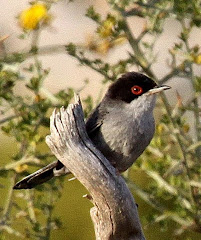
Cyprus Warblers, as the name suggests, are endemic to the island but the related and much more widespread Sardinian Warbler (photo below) is also very frequent. Many Cyprus Warblers leave in winter, only returning in Spring, but the winter-visiting Sardinian Warbler is there much of the time and there are fears that it may be ousting the endemic bird.


Both species like to nest in low bushes amongst the scrub, the Cyprus Warbler being mainly restricted to species of Genista. Both are restless birds but will sometimes perch prominently if curious of human presence. However, the Cyprus Warbler (below) preferred to skulk in the bushes. Both warblers possess a distinctive red eye.

Wood Sandpipers, Asprokremnos pool, Cyprus

May 9, 2010:
As the water level fell on the pool through evaporation and run off, an area of vegetation was exposed. The Moorhen fed widely over it and even the Little Crake ventured away from its reed bed sanctuary.


As dusk was falling two Wood Sandpipers in full summer plumage flew in. Once settled they fed avidly and apparently without concern. Presumably they were newly arrived passage migrants making use of a rest and a stop-over.


Squacco Heron, Asprokremnos and Fassouri, Cyprus

May 8 & 9, 2010:
Squacco Herons are quite common passage migrants in Cyprus often remaining for several weeks at pools and wetlands on the south coast of the island.


Sometimes they are accompanied by other species of heron as well as by Cattle and Little egrets. (Photographed below with a Black-crested Night Heron at Asprokremnos).


Their delicate pale pink-buff plumage with darker stripes made them difficult to see in the drying-out reed beds at Asprokremnos but at those at Fassouri which were much wetter (bottom) or when perched in trees, they were far more obvious.


Several birds were seen at both at Fassouri and at Asprokremnos.

Golden Oriole, Nikokleia, Cyprus

May 8, 2010:
For several days there had been reports of Golden Orioles in the area with three seen by Gerrit near the hotel early one morning. However, they were very mobile never staying in one place for long and so difficult to photograph. The opportunity came one evening when watching from a high vantage point over an orange grove. A bird approached and settled in a tree about 40 metres away but was partly obscured by the leaves. When it changed position slightly there was just time for a couple of shots before it flew off disturbed by a dog barking in the village nearby.


Golden Orioles are mainly passage migrants in Cyprus but have been known to nest occasionally in the Troodos range. When perched in orange trees they can easily be confused with the bright orange fruits.


Nikokleia village with the Oriole orange grove in the middle distance right of centre.


Another bird was seen and heard singing near the Avagas gorge, Akamas.